


What are screws?
Screws are mechanical fasteners with a threaded shaft designed to hold materials together by converting rotational force into clamping force. When a screw is driven into a material or paired with a threaded hole, the spiral thread pulls the screw forward and creates resistance against loosening. This makes screws useful in construction, furniture assembly, electronics, machinery, automotive parts, home repair, and industrial manufacturing.
A typical screw includes several key parts: the head, drive recess, shank, thread, point, and sometimes an unthreaded shoulder. The head provides a surface for clamping or countersinking, while the drive recess allows a tool such as a screwdriver, hex key, or drill bit to rotate the screw. The thread determines how the screw grips the material, and the point controls how easily it starts into the surface.
Who uses screws most often?
Screws are used by homeowners, DIY users, carpenters, contractors, engineers, product designers, machine builders, maintenance technicians, furniture manufacturers, and electronics assemblers. A beginner may use screws for hanging shelves or assembling cabinets, while an engineer may select screws based on torque, tensile strength, thread engagement, vibration resistance, and corrosion performance.
What makes screws different from nails or bolts?
Screws differ from nails because they use threads to create grip and clamping force, while nails mainly rely on friction and shear resistance. Screws are also easier to remove and reinstall. Compared with bolts, screws often cut or engage their own mating thread in the material, while bolts usually pass through parts and are secured with nuts or pre-threaded holes.
Why do screws matter in fastening and assembly?
Choosing the right screws matters because a screw is often a small component carrying a big responsibility. The wrong screw can split wood, strip threads, loosen under vibration, corrode outdoors, fail under load, or damage the surface finish. In production environments, poor screw selection can also slow assembly, increase rework, and create warranty issues.
Screws affect holding strength
Holding strength depends on screw diameter, length, thread design, material hardness, pilot hole size, and how deeply the screw engages the base material. A screw that is too short may not grip enough material, while one that is too thin may bend, snap, or strip under load.
Screws influence surface finish
The head type affects how the finished surface looks. Flat head screws can sit flush in countersunk holes, pan head screws remain visible above the surface, and washer head screws distribute force over a larger area. For furniture, cabinetry, and visible assemblies, the screw head is both a functional and design decision.
Screws help improve repairability
Unlike permanent joining methods such as welding, adhesives, or rivets, screws can often be removed without destroying the assembly. This makes them valuable for products that need maintenance, inspection, upgrades, replacement parts, or disassembly during shipping.
How do you choose the right screws?
Selecting screws is not only about choosing a size. A reliable screw choice should match the base material, working load, environment, installation method, and desired finish. The following five-step process gives beginners and professionals a practical way to narrow down the correct screw.
Step 1: Identify the material
Start by confirming whether the screw will go into wood, sheet metal, plastic, drywall, concrete, or a pre-threaded metal hole. Wood screws usually have coarse threads for better bite. Machine screws are designed for threaded holes or nuts. Self-tapping screws can cut threads into thinner materials, while concrete screws require masonry-compatible designs.
Step 2: Choose the right screw length and diameter
The screw should be long enough to create strong engagement without piercing through the opposite side unless that is intended. A common practical rule for wood projects is to make sure the screw penetrates deeply into the receiving piece, not just the top layer. Diameter matters too: thicker screws provide more strength but may require pilot holes to prevent splitting.
Step 3: Match the head style to the surface
Use flat head screws when the screw needs to sit flush. Use pan head, round head, or button head screws when the head can remain visible. Use washer head screws when the material is soft, thin, or likely to deform. In decorative applications, head shape and finish should also match the product appearance.
Step 4: Select a suitable drive type
Phillips drives are common, but they can cam out under high torque. Torx drives provide better torque transfer and are often preferred in production and construction. Hex socket screws are common in machinery and furniture. Slotted screws are simple but less stable during powered installation.
Step 5: Consider coating and corrosion resistance
Indoor screws may use basic zinc plating, while outdoor or humid environments need stronger corrosion resistance. Stainless steel screws are suitable for many outdoor and marine-adjacent uses, though the exact grade matters. For treated lumber, exterior decking, roofing, and industrial exposure, coating compatibility is especially important.
Screw type comparison table
| Screw Type | Best Used For | Key Feature | Common Mistake |
|---|---|---|---|
| Wood Screws | Furniture, framing, cabinets, general woodworking | Coarse threads grip wood fibers | Skipping pilot holes near edges |
| Machine Screws | Metal parts, threaded inserts, nuts | Uniform threads fit tapped holes | Using the wrong thread pitch |
| Self-Tapping Screws | Sheet metal, plastic, thin materials | Creates its own mating thread | Over-tightening and stripping material |
| Drywall Screws | Fastening drywall to studs | Bugle head reduces paper tearing | Using them for structural loads |
| Concrete Screws | Masonry, concrete, brick | Designed for drilled masonry holes | Using the wrong drill bit size |
Common screw selection mistakes
Even simple fastening work can fail when screws are selected or installed incorrectly. The following mistakes are common in DIY work, furniture production, field installation, and general repair.
- Using screws that are too short: A short screw may hold temporarily but fail under vibration, movement, or repeated loading.
- Choosing the wrong thread type: Fine threads may not grip soft materials well, while coarse threads may not suit thin metal or tapped holes.
- Over-tightening: Too much torque can strip threads, crush soft materials, deform washers, or break the screw head.
- Skipping pilot holes: In hardwood, thin boards, and edge fastening, pilot holes help prevent splitting and improve alignment.
- Ignoring corrosion resistance: Indoor screws may rust quickly in outdoor, coastal, wet, or chemically exposed environments.
- Using the wrong drive bit: A mismatched bit damages the screw recess and makes removal difficult.
- Using drywall screws for everything: Drywall screws are useful for drywall, but they are not a universal structural fastener.
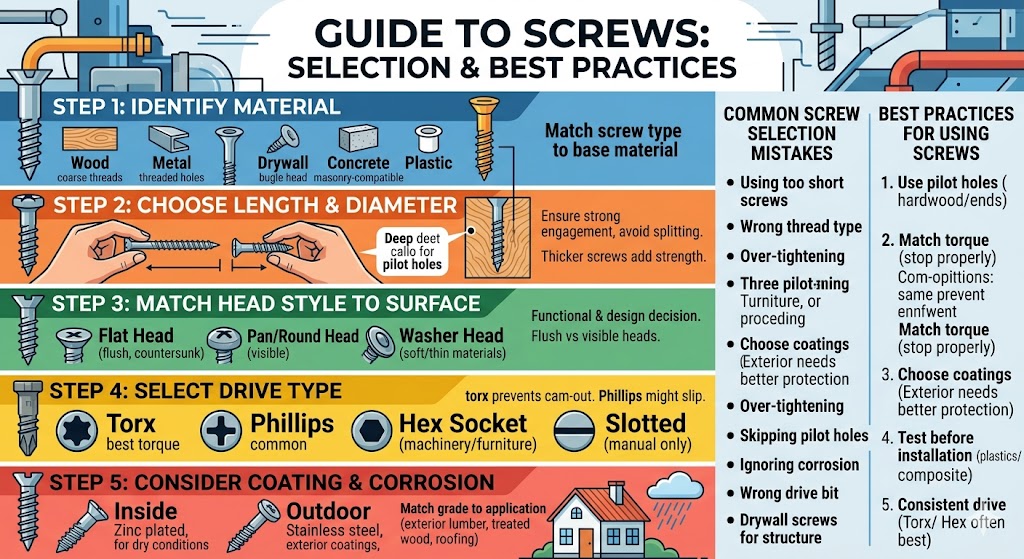
Best practices for using screws
1. Use pilot holes when precision matters
Pilot holes help guide screws, reduce splitting, and lower installation torque. They are especially useful in hardwood, near board ends, in dense plastics, and when installing larger screws. A good pilot hole improves both strength and appearance.
2. Match torque to the screw and material
Powered drivers save time, but too much torque can damage the fastener or the workpiece. Use clutch settings on drills, start slowly, and stop when the screw seats properly. In production work, controlled torque tools can improve consistency.
3. Choose coatings based on the environment
Zinc-plated screws may be acceptable indoors, but exterior environments need better protection. For decks, outdoor furniture, roofing, and equipment exposed to moisture, select screws with suitable coating or stainless steel material.
4. Keep drive compatibility consistent
Using one drive type across a project can reduce tool changes and installation errors. For higher-torque work, Torx or hex socket drives often provide better control than basic slotted or Phillips drives.
5. Test before full-scale installation
When working with unfamiliar material, test one screw first. Check whether the screw drives smoothly, sits correctly, holds firmly, and does not crack or deform the material. This is especially important for plastics, thin panels, composite boards, and visible surfaces.
Conclusion and next step
Screws may look simple, but good screw selection requires attention to material, thread type, length, diameter, head style, drive design, coating, and installation method. For light household tasks, a basic understanding may be enough. For furniture, construction, machinery, and manufacturing, the right screw can directly affect strength, safety, durability, and long-term maintenance.
The next step is to identify the material and environment first, then choose a screw type that matches the application. When strength, corrosion, vibration, or repeated assembly matters, test before full installation and consider professional fastener specifications.
Screws FAQ
Q1: What are screws used for?
Screws are used to fasten, position, adjust, or secure materials together. They are common in woodworking, metalwork, plastic assembly, drywall installation, electronics, furniture, machinery, and home repair because they provide strong holding force and can often be removed when needed.
Q2: How do I choose the right screw size?
Choose screw size by considering material thickness, required holding strength, load direction, and whether the screw must pass through one part into another. The screw should be long enough to engage securely without damaging the opposite side or splitting the material.
Q3: What is the difference between wood screws and machine screws?
Wood screws usually have threads designed to grip wood fibers, while machine screws have uniform threads designed for nuts or pre-threaded holes. Machine screws are common in metal assemblies, equipment, and products that require repeatable assembly and disassembly.
Q4: When should I drill a pilot hole for screws?
A pilot hole is recommended for hardwood, dense materials, large screws, edge fastening, and visible work where splitting would be costly. Pilot holes also improve screw alignment and reduce the torque needed during installation.
Q5: What screw head type should I use?
Use flat head screws when the head must sit flush, pan head screws when a visible head is acceptable, and washer head screws when load distribution matters. The right head type depends on appearance, clamping area, and surface requirements.
Q6: Are stainless steel screws always better?
Stainless steel screws are excellent for many corrosion-resistant applications, but they are not always the best choice for every load or cost requirement. Some applications need hardened steel, coated steel, or specific grades depending on strength and environment.
Q7: Why do screws strip during installation?
Screws strip when the drive recess or material threads are damaged. Common causes include using the wrong bit, applying too much torque, driving at an angle, using low-quality screws, or installing into material that cannot support the thread pressure.
Q8: Can screws be reused?
Some screws can be reused if the threads, head, and drive recess are not damaged. However, screws used in critical loads, safety-related assemblies, or high-vibration environments should be inspected carefully and replaced when reliability is uncertain.
Q9: What screws are best for outdoor use?
Outdoor screws should resist moisture and corrosion. Stainless steel, hot-dip galvanized, or exterior-coated screws are common choices. The best option depends on exposure level, wood treatment, weather, chemicals, and whether the project is structural or decorative.
Q10: What is the strongest type of screw?
There is no single strongest screw for every situation. Strength depends on material grade, diameter, thread engagement, installation quality, base material, and load direction. For critical applications, screw specifications should be selected according to engineering requirements.
